Case study
Building an inventory system inside a WordPress form builder
A form builder isn’t a store. It has no products, no catalog, no cart. So when people started asking Fluent Forms to “only let 50 people register” or “sell 20 tickets and then close,” the interesting part wasn’t the feature — it was doing it without pretending to be a commerce plugin.
The problem
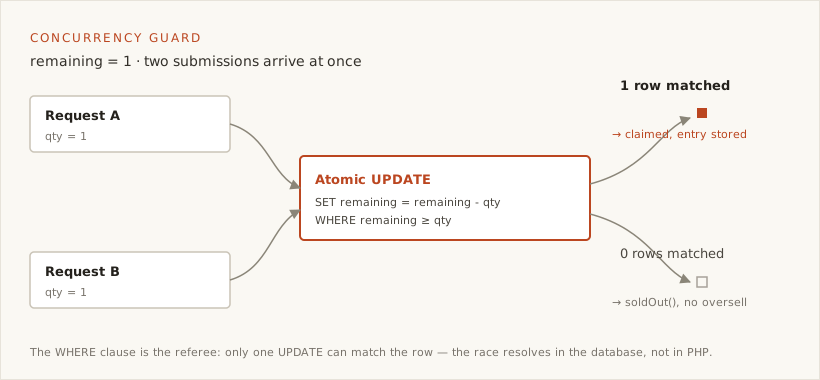
The request sounds small: a field with a quantity, that decrements on submission, and blocks once it hits zero. It stops being small the moment two people submit the last unit at the same time. A naive “read count, compare, then write” leaks oversells under any real traffic — exactly the moment a launch actually matters.
The constraints that shaped everything:
- No product model. Inventory had to attach to a field option, not a first-class product entity, because that’s the mental model form builders have.
- Concurrency is the whole game. The rare path (two submissions racing for the last slot) is the only path that matters. If it’s wrong, the feature is a lie.
- It had to survive imports, edits, and duplication. People clone forms and edit fields constantly. Inventory state couldn’t live somewhere that a routine edit would silently reset.
- Backward compatibility. Existing forms and submissions had to keep working, untouched, with inventory simply absent.
Architecture
Inventory is modeled as stock counters keyed to a form field and its option value, stored separately from the form definition. The form definition stays declarative (“this field has inventory enabled, initial stock N”); the live counts live in their own table so editing a form never clobbers real sales.
The decrement happens inside the submission insert path, not before it:
// Reserve inside the same transaction that stores the entry.
// The UPDATE ... WHERE remaining > 0 is the atomic guard: the row
// itself refuses to go negative, so the race is resolved by the DB,
// not by PHP reading-then-writing.
$claimed = $db->query(
    "UPDATE {$stockTable}
        SET remaining = remaining - ?
      WHERE field_key = ? AND option_hash = ? AND remaining >= ?",
    [$qty, $fieldKey, $optionHash, $qty]
);

if ($claimed < 1) {
    // Someone else took the last of it between render and submit.
    return $this->soldOut($fieldKey);
}
The rule that makes it correct: the check and the decrement are the same
statement. WHERE remaining >= ? means the database refuses to oversell; two
racing submissions can’t both win because only one UPDATE actually matches the
row. PHP never holds the truth long enough to be wrong about it.
Trade-offs
- Atomic UPDATE vs. row locks. An explicit
SELECT ... FOR UPDATEthen write would also work, but it holds a lock across more PHP execution and interacts badly with the plugin’s varied hosting reality (shared hosts, aggressive timeouts). A single guardedUPDATEkeeps the critical section as small as physically possible. - Reservation vs. hard decrement. True “hold the slot for 10 minutes while you pay” reservations are a different, heavier system. For most forms, decrement-on- submit is the honest match to how people actually use them; reservations were scoped out deliberately rather than half-built.
- Field-scoped, not global. Keying stock to
field_key + option_hashmeans duplicating a form starts fresh stock instead of secretly sharing a counter with the original — the behavior people expect, at the cost of some bookkeeping when fields are renamed.
What it taught me
The feature is 90% edge cases and 10% happy path, and the 10% was never the
risk. Every hard decision came from refusing to let PHP be the source of truth
for something two requests can touch at once. When state is contended, push the
invariant down to the layer that can actually enforce it — here, a WHERE clause
— and keep the window where you could be wrong as narrow as the platform allows.
The other lesson was about restraint: the right version of this shipped without becoming a commerce system. Naming the thing it deliberately isn’t (“this is not reservations, not a catalog”) was as important as the code.